
Phishing approvals, leaked keys, fake support, rug-pulled platforms, pig-butchering "investments"… the methods vary, but victims' first reaction is usually the same: "The chain is anonymous, the money's gone, accept it."
The truth is the opposite: the public, transparent, immutable nature of blockchains is precisely what makes tracing possible. Every transfer is permanently recorded and every flow leaves a trail. What determines whether recovery can move forward was never "can the chain be examined" — it is whether the method is professional, the action timely, and the evidence complete.
Delta & Capital emphasizes one premise in such cases: on-chain tracing is not "a hacker transferring your coins back" — it is evidence plus compliant process, advanced together with law firms and judicial authorities. By the end you will understand: why crypto is traceable, the common theft types, what to do first after a theft, how professional tracing works, the practical obstacles, and what expectations of "recovery" are reasonable.
1. Why crypto assets are traceable
Bitcoin uses the UTXO model — every transaction works like making change, leaving relatively clear paths. Ethereum and TRON use account models, where each address records balances and interactions. Either way, all transactions are publicly recorded and immutable.
Even funds that pass through many layers, split into countless small amounts, or hop chains via bridges can still be reconstructed into an approximate flow path. Combined with address labels and risk profiling, analysts can identify which addresses are exchanges, which are mixing services, and which are scam-linked or high-risk. In short: scammers can move funds, but they can hardly erase the trail.
2. Common types of theft and fraud
Different types demand different priorities — find your case first:
- Phishing approval (Approve scam): you clicked "approve" on a fake site, and the scammer drained tokens using that approval. The hallmark: assets moved by authorization, not by key leakage.
- Private key / seed phrase leak: the key was phished or exposed in an unsafe environment; the wallet is fully controlled and emptied.
- Fake platform / wallet app: you installed a counterfeit app; deposits go in, withdrawals never come out, the platform vanishes.
- Fake support / fake investment (pig-butchering): induced transfers to designated addresses, or "investments" on fabricated platforms that never return.
Knowing your case type tells you which evidence to prioritize, where the funds left, and whether a reachable landing point still exists.
3. Before any recovery: fix the evidence
After a theft or scam, time is everything — the faster funds move, the shorter the tracing and interception window. Immediately preserve, as completely as possible:
- the theft/scam transaction hashes (TxID) and timestamps;
- every address involved (yours, the counterparty's, transit addresses);
- approval records (for phishing approvals);
- transfer screenshots and wallet records;
- chats, emails, and call logs with the counterparty;
- account, order, and support-ticket records on the platforms involved.
The more complete the evidence and the clearer the timeline, the stronger every later step. File a police report promptly and keep the receipt — it is the prerequisite for judicial cooperation and platform assistance. Note: reporting and on-chain tracing complement each other; civilian analysis supplies leads, but the power to freeze and claw back rests with judicial authorities.
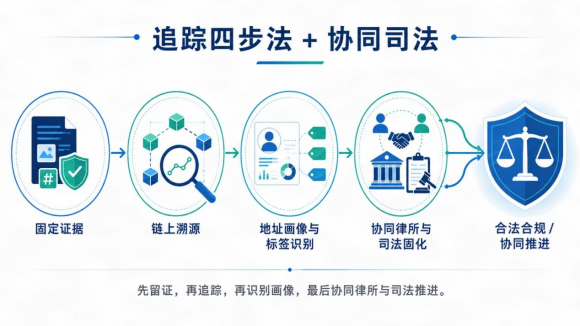
4. How tracing works: Delta & Capital's four-step method
Step 1 | Fix the evidence: preserve transaction hashes, addresses, and communications in full; establish the complete timeline so every transfer can be matched.
Step 2 | On-chain tracing: starting from the theft transaction, follow the funds hop by hop, labeling each hop's address type (personal, exchange, contract, mixer) and destination to draw the flow map.
Step 3 | Address profiling and label recognition: identify exchange addresses, mixing services, or high-risk addresses where funds landed, and judge whether a reachable landing point exists — e.g. funds entering a KYC platform that can cooperate. This usually decides whether the case can move.
Step 4 | Law-firm/judicial solidification: assemble the analysis into an evidence chain usable for police reports, cooperation requests, or litigation, and advance freezing and recovery lawfully with lawyers and authorities. This step turns on-chain leads into results.
5. Real-world difficulties in tracing
Even professional teams are not omnipotent. These situations raise difficulty sharply:
- Mixing services: funds are shredded and blended, paths deliberately blurred, and tracing costs soar.
- Cross-chain bridges: funds hop between chains; only cross-chain analysis capability can reconnect the path.
- OTC / underground banking off-ramps: funds convert to fiat or other forms off-exchange — the on-chain trail breaks there.
- Offshore, no-KYC platforms: funds land somewhere unreachable or uncooperative; even when identified, freezing is hard to advance.
Knowing these difficulties sets realistic expectations — and inoculates you against "we can recover anything" sales talk.
6. Keep expectations about "recovery" realistic
Traceable does not mean recoverable. Whether funds reached a reachable platform, were frozen in time, and receive judicial and platform cooperation all shape the outcome. Anyone promising "100% recovery", "pay and it's back instantly", or "inside connections guarantee it" is almost certainly running a secondary scam on victims.
There is only one legitimate route: complete evidence, lawful channels, and professional forces working with judicial authorities to maximize the odds — not promising an outcome nobody can guarantee.
7. A de-identified example (illustration only)
A user clicked a phishing link and approved it; the wallet's USDT was drained. The approach: fix the approval records and theft hashes, revoke remaining risky approvals, and report immediately; then trace from the theft transaction hop by hop, finally finding part of the funds entering a KYC exchange address — a reachable landing point. The analysis was assembled into an evidence chain for lawyers and judicial follow-up.
8. Closing
After a theft or scam, the earlier you fix evidence and run professional tracing, the more room there is to act. The chain is not lawless — and not hopeless.
Delta & Capital is a professional firm focused on blockchain data auditing, compliance consulting, and technical analysis. Its team of licensed legal experts and senior on-chain data engineers serves global clients with account risk-control appeals, source-of-funds (SOW) guidance, and cross-border compliance dispute resolution.
9. FAQ
Q1: Can stolen crypto really be traced on-chain?
Fund flows can be traced. Transactions are public and immutable; professional analysis can reconstruct the approximate path and identify address types. Recovery still depends on where funds land and on judicial/platform cooperation.
Q2: What is the first thing to do after a theft?
Fix the evidence immediately: hashes, addresses, approval and transfer records, communications — and report to police fast, pushing for cooperation before funds move on.
Q3: Funds already went into a mixer or unknown address — any hope?
Harder, but not hopeless. Tracing can keep labeling paths and potential landing points; the key is reaching a cooperative platform and judicial support.
Q4: How do I avoid secondary scams during "recovery"?
Beware of any "guaranteed recovery" or "deposit first" pitch and verify official channels. Delta & Capital advances cases strictly on evidence and compliant process.
Q5: Police report vs. professional tracing — is it either/or?
No. They complement each other: the report starts judicial procedure and unlocks freezing powers; professional analysis supplies the clear flow map and evidence chain. Together they move faster.
Q6: After a phishing approval, what else besides tracing?
Revoke risky approvals at once, move remaining assets to a safe address, fix the evidence, report quickly, and then begin tracing.
Risk notice: this article is compliance education, not a promise of recovery; outcomes depend on the case, fund flows, and judicial cooperation. Pursue rights through lawful channels and beware of secondary scams under borrowed names.