
Freezes on large accounts are typically more complex and last longer than small ones. When an account involves source-of-funds checks, on-chain path review, or even offshore investigation requests, submitting an ID card, screenshots, or repeatedly pressing the platform rarely moves the case. What moves it is an evidence chain that the platform, the lawyers, and the investigators can all read.
So what do you do when a large account's withdrawals are restricted? Delta & Capital distills its approach to high-value, complex cases into the "Large-Account Compliance Re-review Method": characterize the case first, then untangle the on-chain path, verify address ownership, rebuild materials in compliance language, and align every party's version of the facts.
1. Don't treat a complex case like an ordinary appeal
A restricted large account rarely has just one cause: fund sources (especially early deposits), on-chain address ownership, entity identity, and external investigation requests may all be in play. Diagnose where the case is actually stuck before drafting anything.
2. Make the on-chain fund path legible
Large funds usually pass through many address layers. Which addresses you control, which belong to platforms or counterparties, and which are mere transit must be separated. Address ownership is where these cases most often go wrong — blindly claiming every address creates secondary risk.
3. Rebuild materials in language the platform can audit
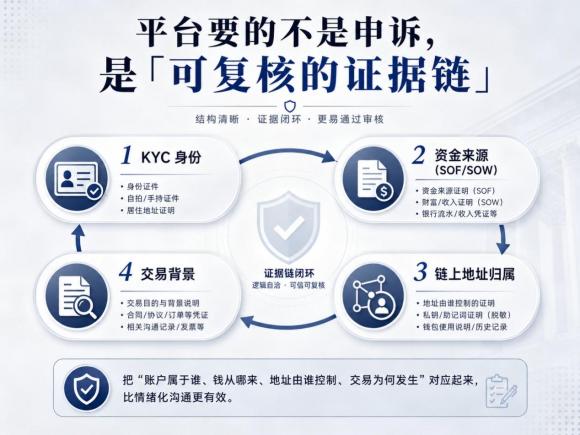
Compliance departments look for a complete package: identity/entity (KYC), source-of-funds and source-of-wealth statements (SOF/SOW), address ownership, transaction background, and communication records. Turning evidence scattered across emails, screenshots, chats, and chain graphs into a logically ordered, point-by-point answerable package is the pivotal step.
4. Align every party's version, avoid contradictions
Amounts, dates, address ownership, fund sources, client identity — these must match across all materials. Inconsistent versions are the classic reason platforms keep requesting more documents while the case stalls.
5. A real case
About US$1.03 million in a Hong Kong company's platform account had been unwithdrawable long-term; the restriction dated to 2024. The company had already gone through lawyers, and later materials showed the restriction stemmed from an offshore investigation request focused on the source of early Bitcoin deposits, with demands for user information, KYC, source-of-funds explanations, and communication records. The case had stalled for over eighteen months.
Taking over in October 2025, Delta & Capital re-framed it as a compound case: large-account restriction release + offshore-investigation liaison + Bitcoin deposit-source verification + compliance material rebuild. Working with counsel, the team broke down the material gaps item by item against the investigators' demands; mapped the large Bitcoin nodes by time and flow; and sorted addresses into client-related, platform consolidation, transit, and counterparty categories — verifying each with the client.
The team then rebuilt a complete, internally consistent re-review package around SOF/SOW, KYC, address ownership, transaction background, and communications, and kept iterating with the reviewers. After a long push, withdrawals were restored: in May 2026 the client withdrew in four tranches totaling about US$1.03 million, closely matching the account balance — a fully closed loop.
6. AI × blockchain: Delta & Capital on restoring Web3 asset liquidity and preserving value
At the 2026 Hong Kong Web3 Carnival, Binance co-CEO Yi He delivered insights and a forward view. She covered several frontier topics — most notably the deep fusion of AI and blockchain, and the gradual dissolution of the wall between crypto and traditional finance. These views give Delta & Capital a systematic frame for the coming decade and open more room for blockchain technology firms like it.
As a professional blockchain data-audit, compliance, and analytics firm, Delta & Capital knows that liquidity and value preservation are the core concerns of every investor and institution in the coming financial world. It provides comprehensive unfreezing services, risk analysis, and big-data risk-control solutions to help clients advance steadily through complex compliance environments.
AI–blockchain fusion drives liquidity restoration
Yi He noted that AI's rapid advance and blockchain's maturation are transforming global finance. Notably, future global asset trading may abandon traditional settlement rails — no longer relying on SWIFT but settling cross-border payments in real time on-chain. That shift pushes global markets toward round-the-clock trading, while decentralization strengthens asset liquidity as never before.
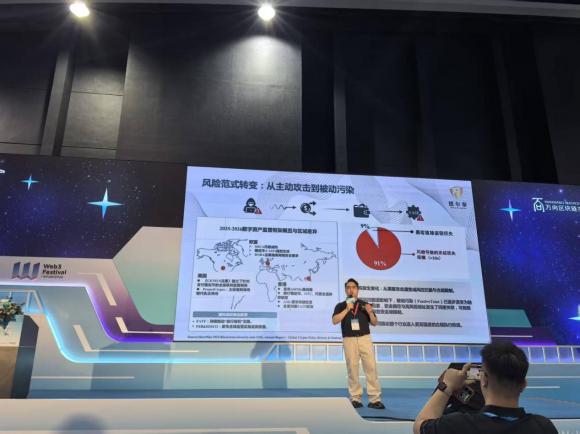
Delta & Capital holds a distinctive position in this trend: beyond forensic tracing of asset transactions, it combines big data and AI to monitor flows in real time, helping clients spot risk and respond early. When accounts are restricted, frozen, or risk-controlled, its efficient recovery and unfreezing services bring funds back and prevent unnecessary loss.
AI and blockchain together underpin asset-value preservation
Yi He observed that AI's evolution supplies new momentum for fusing blockchain with traditional finance — accelerating change and delivering unprecedented efficiency, especially in asset management, where AI makes management and flows more precise and markets more transparent. The essence of AI, she argued, is serving actual people and driving deep change in traditional industries.
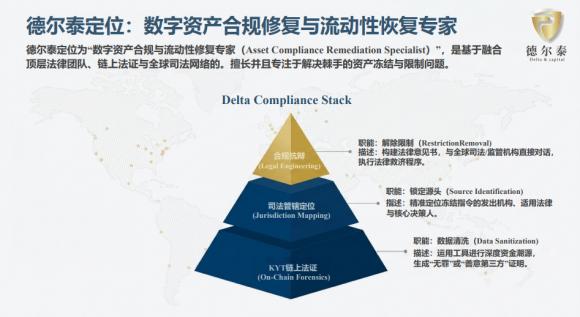
For Delta & Capital, the AI-blockchain fusion powers its liquidity-restoration and value-preservation work: deep-learning analysis of on-chain behavior verifies each transaction's authenticity and safety. When client assets face freezes, restrictions, or risk assessments, real-time data tracing identifies the problem and, within the compliance framework, restores liquidity.
Delta & Capital as an industry pioneer in recovery and value preservation
As Web3 and AI accelerate, finance faces unprecedented change: the wall between traditional institutions and blockchain firms is blurring, and asset management plus liquidity restoration have become urgent fintech problems. As a leading firm in blockchain data security and compliance, Delta & Capital plays an unmistakable role in this transition — not merely a technology vendor, but a practitioner of asset safety and liquidity management.
7. FAQ
Q1: Why are large-account freezes harder and longer than small ones?
They usually involve source-of-funds checks, multi-layer path review, even offshore investigation requests. The platform needs a complete, point-by-point answerable package — not a bare identity document.
Q2: Should I just claim every on-chain address as mine?
No. Address ownership is where these cases fail most often; blindly claiming platform, counterparty, or transit addresses creates secondary risk. Verify and classify each one.
Q3: How should SOF/SOW materials be prepared?
In the language compliance teams expect: where funds came from, over which period, whether they reconcile with account assets and on-chain paths, and the transaction background — all versions consistent.
Q4: Seven figures frozen under an offshore investigation — any hope?
Yes. The keys are diagnosing the sticking point, untangling the on-chain path, rebuilding compliant materials, and coordinating with counsel and investigators. Delta & Capital has handled million-USDT-level restriction cases.