
Many people know the confusion: I did nothing, received a normal USDT payment, and suddenly my exchange account is risk-controlled and withdrawals blocked. To explain it, you must understand a mechanism ordinary investors rarely see but which affects their money constantly — on-chain AML, or KYT.
From Delta & Capital's practice handling freeze cases for platforms and individuals, the vast majority of "inexplicable" freezes can be fully explained by KYT logic.
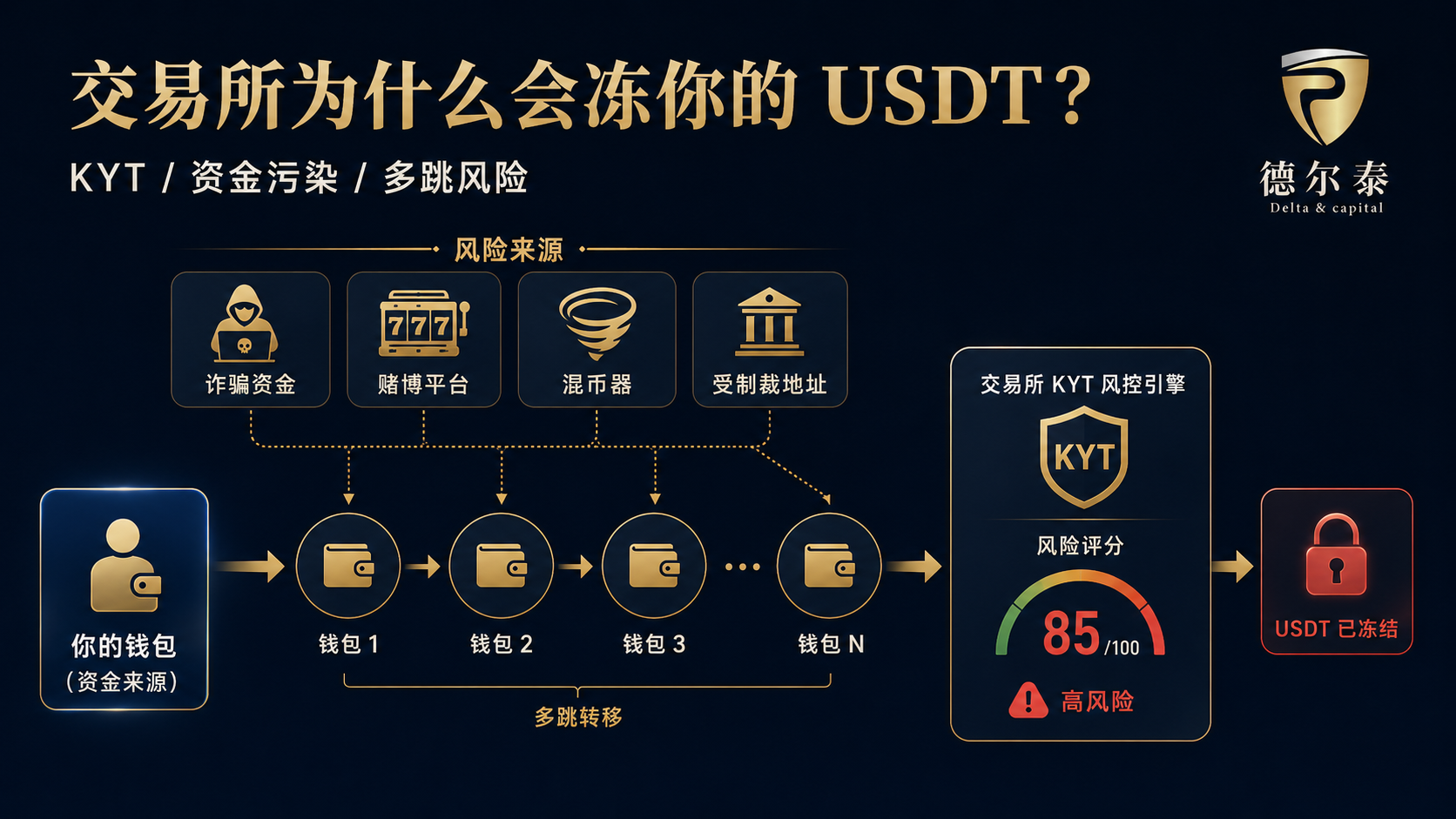
1. KYC vs. KYT: two easily confused concepts
KYC (Know Your Customer): answers "who you are" — identity verification at account opening.
KYT (Know Your Transaction): answers "is this money, this address, clean" — at the instant you deposit, withdraw, or trade, it judges whether the counterparty address touches scams, gambling, sanctions, or mixers.
For exchanges, wallets, and payment firms, KYT is the core of AML compliance. It decides whether your transaction passes, needs extra verification, or gets blocked.
2. What KYT evaluates: address risk and fund taint
The key concept: funds get "tainted". KYT systems score every address and every sum — looking not only at whether you are clean, but whether the money you received touched scams, gambling, mixers, or sanctioned addresses a few hops back.
An address's risk depends not only on itself but on its "fund distance" to high-risk entities: direct trades with case-involved addresses are extreme risk; several hops removed, risk decays sharply.
3. Why can I get risk-controlled without doing anything wrong?
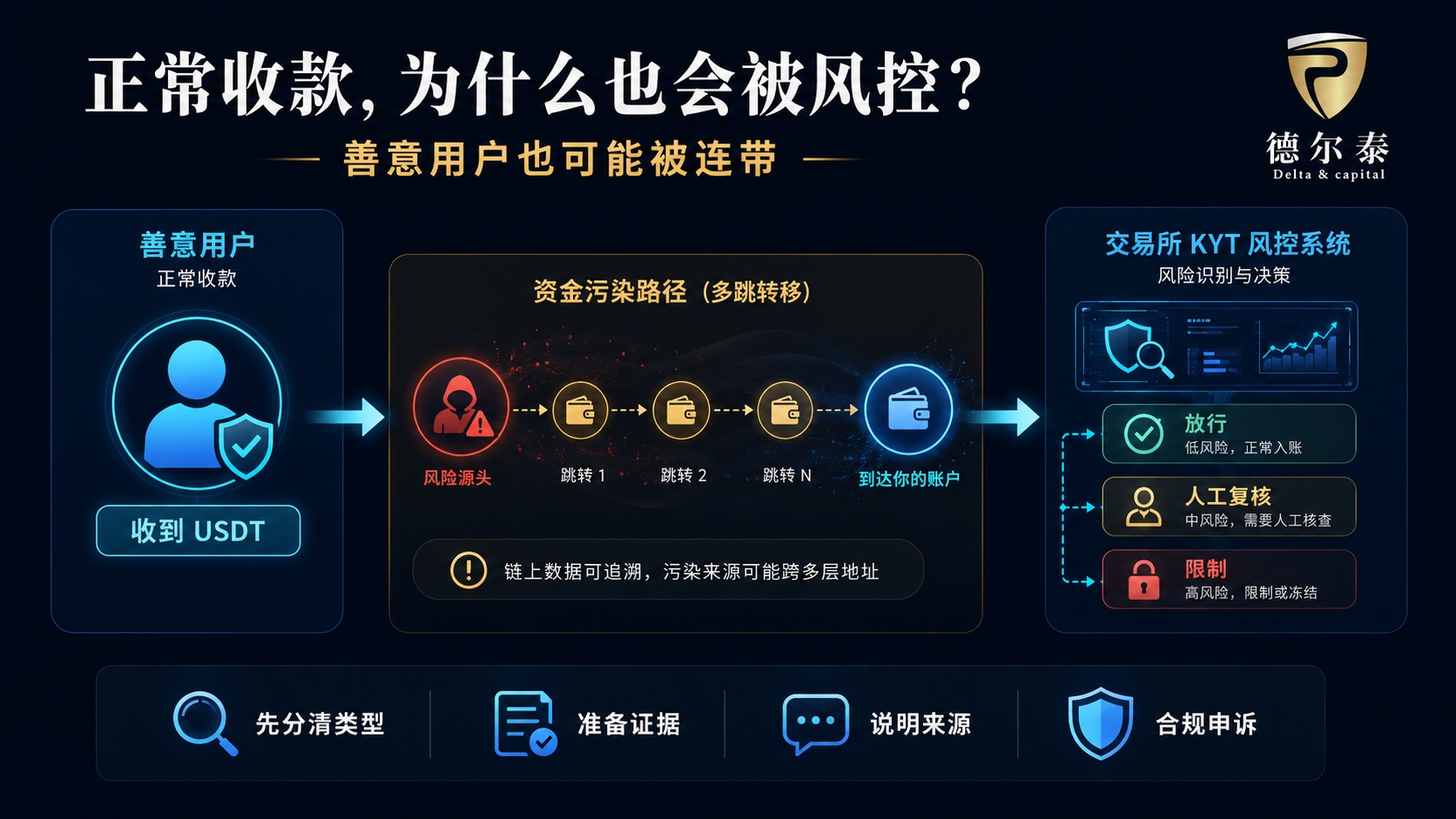
Hence the most unjust scenario: a normal OTC sale, but the buyer's USDT came through a case-involved address a few hops earlier — and your account is dragged in by the funds' tainted résumé.
That is why normal users get frozen: risk controls freeze the "fund's risk", not necessarily the person. Delta & Capital has handled masses of these innocent-third-party cases — the difficulty was never proving you are good, but using on-chain evidence to explain the money's origin.
4. What does the platform do with the risk verdict?
Once KYT delivers a verdict, platforms typically respond by risk tier:
- Low risk: pass directly;
- Medium risk: route to human review, or request supplementary materials;
- High risk (suspected sanctions or scam links, or mixer exposure within two hops): temporarily restrict the account or a specific withdrawal.
Genuinely compliant risk control stresses explainability and traceability — every interception should have a clear reason and a reviewable basis, not crude one-size-fits-all blocking.
5. Takeaways for ordinary investors
- Trade on regulated platforms with real-name KYC and compliant risk controls; avoid direct dealings with addresses of unknown origin;
- In OTC trades, stay alert to fund sources and vet counterparties before large receipts;
- Keep complete transaction records: once risk-controlled, clear records and source-of-funds statements are the key to release;
- When frozen, identify the type first — platform risk control vs. judicial freeze — since the two demand completely different handling.
6. Summary
An account freeze usually means the funds' on-chain résumé tripped the rules — not that something is wrong with you. Understanding KYT logic, disciplining trading habits, and preserving source-of-funds evidence are the most practical ways ordinary investors reduce the odds of being caught in the crossfire.
7. FAQ
Q1: What is KYT and how does it differ from KYC?
KYC verifies "who you are"; KYT judges "whether this transaction and address are clean". KYT is the core of exchange AML risk control.
Q2: I received a normal payment — why was I frozen?
Likely the funds touched a high-risk address a few hops back and taint dragged you in. Risk controls freeze the fund's risk, not necessarily you.
Q3: What should I do after a risk-control freeze?
First separate platform risk control from judicial freezing, then prepare clear source-of-funds evidence; proceed through compliant channels, professional service firms, or lawful judicial procedure — never trust "pay for an inside unfreeze" middlemen.
Content support: this article's on-chain compliance and AML explainer content is supported by the Delta & Capital technical team, which focuses on blockchain data analytics, on-chain AML risk control, and compliance research. It is public-interest education, offers no unfreezing promises, and does not replace legal procedure.
Risk & compliance notice: this is anti-fraud and investor education, not investment advice, and makes no "guaranteed recovery" or "guaranteed unfreezing" promises. If assets are stolen, pursue rights through lawful channels immediately and beware of secondary scams under "recovery"/"unfreezing" names.