
In crypto theft cases there is a counterintuitive fact: many emptied wallets never leaked a key or seed phrase. The money left "legitimately" — the problem is usually one induced "approval".
From Delta & Capital's post-mortems of stolen-asset cases, the vast majority of token thefts on Ethereum, TRON, and similar chains stem not from leaked keys but from abused approvals. In plain language: how these attacks happen, why they are so hard to spot, and how ordinary users protect themselves.
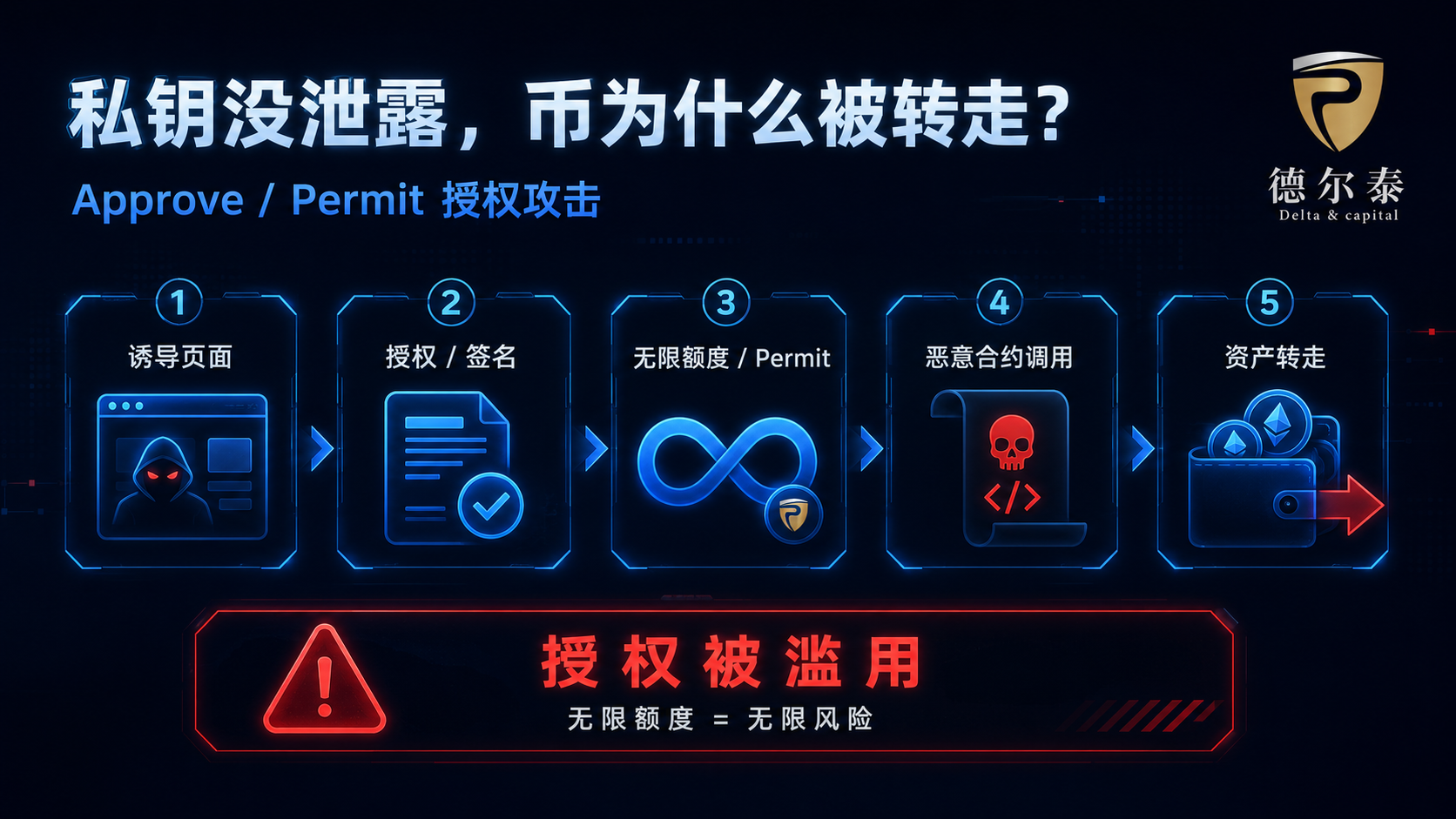
1. Theft ≠ key leak: first understand what an approval is
On chains like Ethereum and TRON, the USDT and tokens in your wallet are really one line of balance recorded in a contract. When you click "Approve" in a DApp, you are telling the token contract: "allow this address to move my coins up to a set allowance."
The mechanism underpins normal DeFi — without approvals, trading, swapping, and staking cannot touch your coins. The risk: grant an approval to a malicious address and it can move coins within the allowance at any moment, without your knowledge, needing neither your key nor any further confirmation.
That is why, in a theft post-mortem, Delta & Capital's first move is pulling the victim address's full approval history — the answer is usually there.
2. The three most common approval traps
In anti-fraud and case-assistance practice, nearly all emptied wallets fall into these three:
- Unlimited-allowance approvals. Fake airdrops and mint sites have you click an innocuous button that actually grants a contract unlimited allowance over one of your tokens. Once confirmed, they can drain that token at any time. Many victims are fine for months — then robbed — because the approval sat on-chain the whole time.
- Offline-signature (Permit) blind signing. Subtler: "just sign, no gas fee". You think it is a login or verification; you actually signed an authorization to move your coins. No transaction on-chain, no gas — victims rarely notice.
- NFT batch approval (setApprovalForAll). One approval hands your entire NFT collection to the counterparty. Fake free mints and airdrop-claim pages love this one.
Their common trait: the interface looks harmless; the signature hides a transfer of control. The scammer wants not one payment but a long-term pass to empty your wallet repeatedly.
3. Why chasing after the fact is far harder than preventing
Delta & Capital must be candid: once approval theft succeeds, tracing and remediation are usually harder than for ordinary transfer theft. Because:
- these rings run automated pipelines — the moment an approval lands, scripts drain the coins within seconds, then rapidly disperse, chain-hop, and mix;
- once funds enter mixers or channels without KYC, reachable landing points collapse.
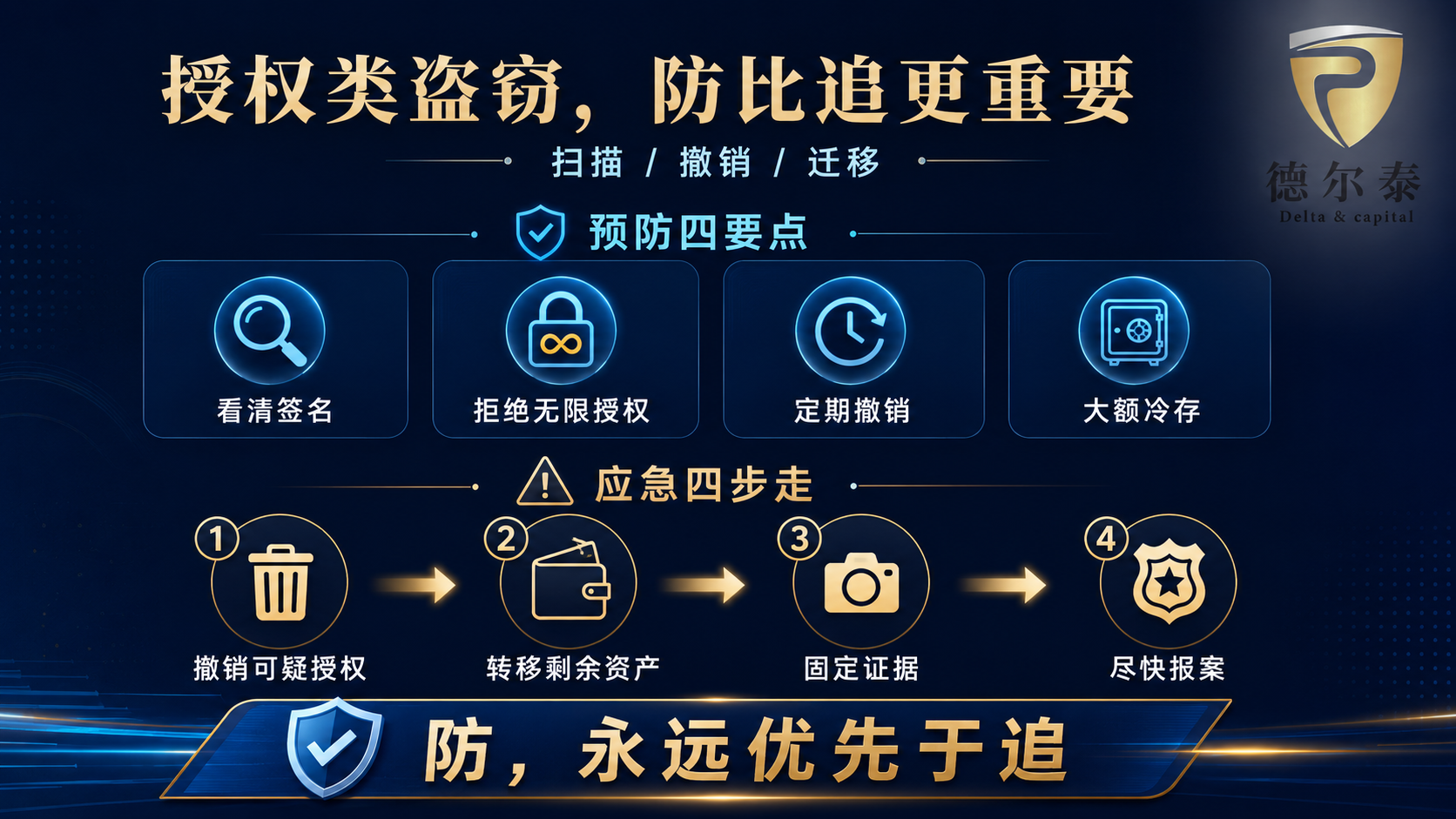
So for approval attacks the most valuable sentence is: prevention always beats pursuit. A few seconds checking a signature beats months of running around afterwards.
4. An everyday self-protection checklist (worth saving)
- Read what you sign: whenever Approve, Permit, or setApprovalForAll appears, verify the counterparty first and refuse blind signatures you don't understand;
- Refuse unlimited allowances: switch to as-needed amounts wherever possible — approve only what you use;
- Review and revoke regularly: use reputable allowance-management tools and clear out unused approvals;
- Cold-store large sums separately: split your interaction wallet from your vault wallet; keep only small change in the former;
- Beware gas-free signatures and "free claims": the free signature is often the most expensive trap.
5. Suspect you've been hit — what now?
- Revoke all suspicious approvals immediately, especially unlimited ones and NFT batch approvals;
- move remaining assets at once to a brand-new address that has never interacted anywhere;
- fix the evidence completely: theft hashes, suspicious addresses, phishing sites / signature records — screenshot everything;
- report to the police immediately and keep the receipt — the prerequisite for judicial procedure and cooperation;
- distrust every "guaranteed recovery" DM: high deposits and 100% promises are almost always aimed at scamming you a second time.
6. Summary
An emptied wallet is very often not a key leak but one induced approval signature. Read signatures, refuse unlimited allowances, revoke regularly, cold-store large sums — and you block the vast majority of this risk. Against approval attacks, prevention always beats pursuit.
7. Key concepts at a glance
- Approve: permits an address to move a given token in your wallet up to an allowance. The foundation of DeFi — and the entry point of approval theft.
- Permit (offline signature): completes an approval with an off-chain signature — no transaction, no gas, and therefore the most deceptive.
- setApprovalForAll: a single approval granting control of your entire NFT collection.
- Mixer: pools many users' funds and splits them back out, severing the source-destination link and sharply raising tracing difficulty.
8. FAQ
Q1: My key never leaked but my USDT is gone — what happened?
Most likely you once granted an approval to a malicious contract. With that approval they can move your coins within the allowance — no key needed.
Q2: How do I see which contracts my wallet has approved?
Use reputable allowance-management tools to review and revoke, watching especially for unlimited allowances.
Q3: Can approval-stolen coins be recovered?
Depends on whether proceeds enter KYC exchanges and whether they pass through mixers. Automated theft is hard to trace — prevention beats pursuit.
Content support: this article's on-chain security and anti-fraud content is supported by the Delta & Capital technical team, which focuses on blockchain analytics, on-chain forensics, and Web3 security-compliance research. Public-interest education only; no recovery promises; not a substitute for legal procedure.
Risk & compliance notice: anti-fraud and investor education, not investment advice, with no "guaranteed recovery"/"guaranteed unfreezing" promises. If assets are stolen, act through lawful channels or professional firms immediately and beware of secondary scams.