
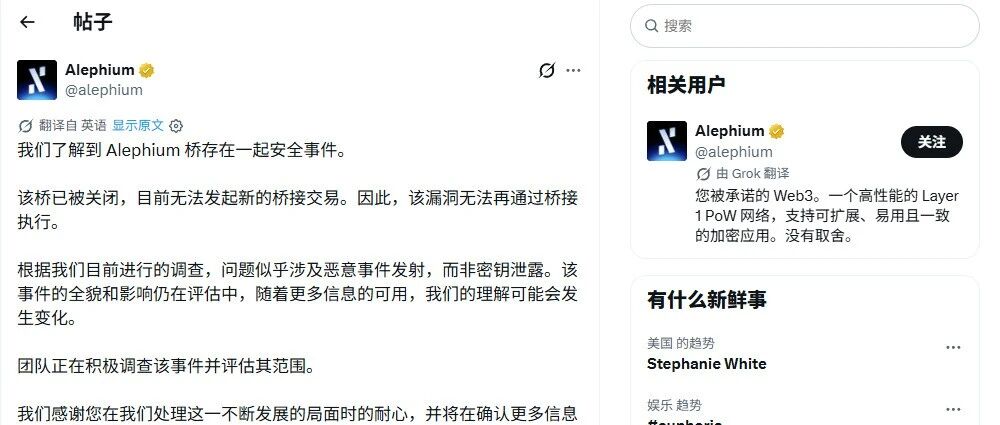
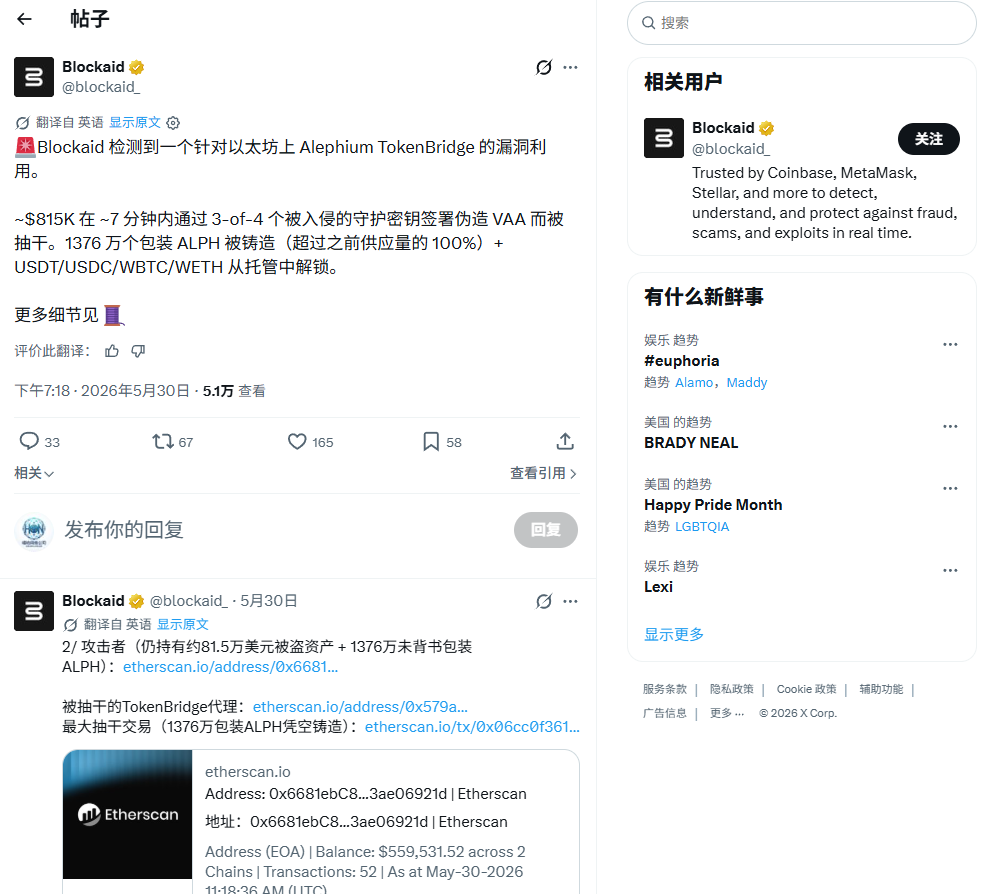
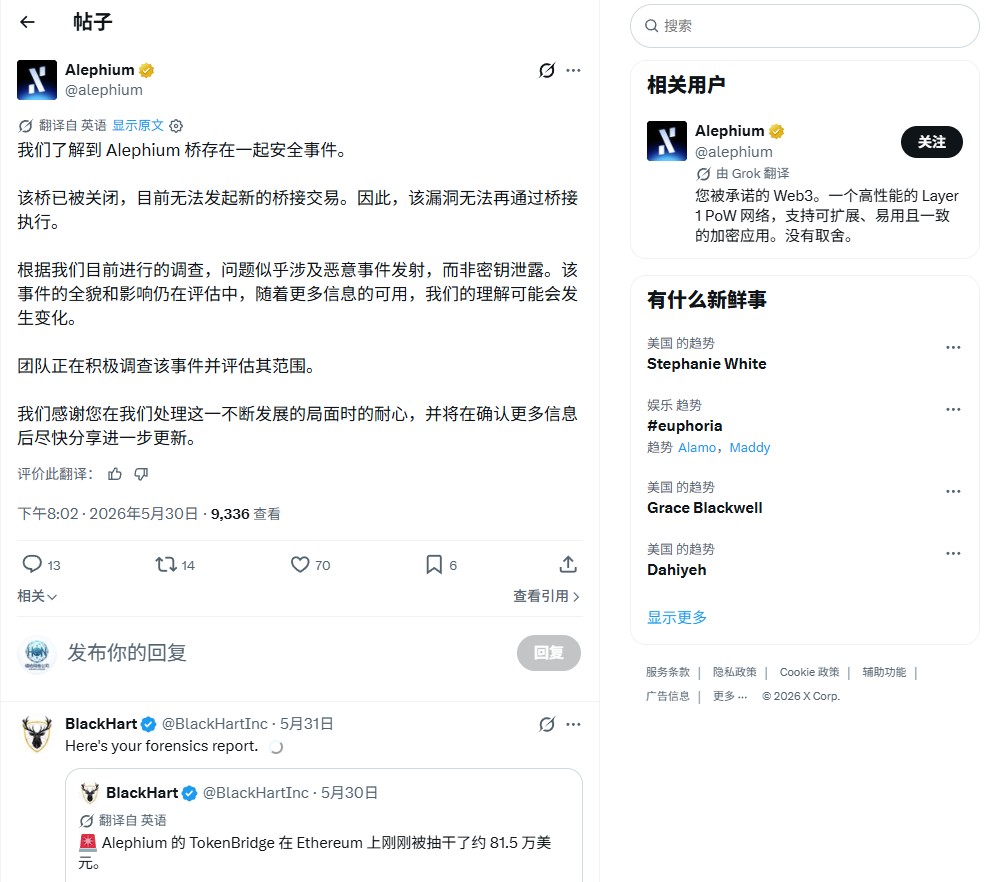
On May 30, the cross-chain bridge sector saw another incident that drew industry-wide attention. PoW chain Alephium (ALPH) officially confirmed that its TokenBridge had been attacked: the attacker exploited a vulnerability in the bridge backend to push forged messages through guardian-network validation and complete a large-scale asset transfer. The entire process took less than 7 minutes.
According to data disclosed by Alephium, the attacker moved roughly $815,000 worth of assets out of the bridge pools on Ethereum and BNB Chain, while also minting 13.76 million Wrapped ALPH backed by nothing at all. After the incident, Alephium shut down the bridge as an emergency measure and suspended all new bridging transactions.
For many users and project teams, an $815,000 loss is hardly the year's largest security incident. But the problems this attack exposed may deserve more attention than the number itself — raising core defensive questions such as how to respond when a private-key compromise blocks your assets or how to lift restrictions on a wallet address.
1. How forged messages fooled the guardian network (and what to do when key compromise blocks your assets)
Delta & Capital's technical team found that early market chatter framed the incident as a "guardian private-key leak", since the attack path resembled the Gravity Bridge incident earlier this year, where the attacker abused signing-node issues to steal assets.
As the investigation progressed, both Alephium and security firm Blockaid revised that view. Public information now shows the attacker never obtained any guardian keys. The problem was the data source feeding the guardians.
Think of a cross-chain bridge as a cross-border banking system: the guardians are the approvers who review remittance requests. Normally, an approver signs after receiving a genuine transfer request. In this attack, the application form itself was forged.
Due to an edge-case vulnerability, the backend fed fake cross-chain events to the guardian nodes for validation. The guardians signed exactly as designed — the signing process itself was flawless — but the data being signed was already poisoned. Multiple legitimate signatures ended up jointly authorizing a forged cross-chain message. From the blockchain's perspective every signature was valid; authenticity had been lost before signing.
That is why Alephium's follow-up announcement stressed that this was neither a smart-contract bug nor a private-key leak — the vulnerability sat in the off-chain bridge backend. It is also a wake-up call for high-net-worth users: how do you respond when a compromised environment blocks your assets? The answer requires a professional compliance plan built on physical isolation and proof of ownership.
2. A four-guardian design amplified the risk (and how to lift wallet address restrictions)
One detail sparked debate among researchers. Alephium runs a private fork of the Wormhole protocol. Per the project's disclosures, its guardian network has 4 Guardians with a 3-signature threshold. Wormhole mainnet, by contrast, runs 19 Guardians and requires 13 signatures.
What does that mean? If the backend mistakenly feeds a forged message to one guardian, on Wormhole mainnet the attacker still needs 12 more approvals. Under Alephium's architecture, just two more signatures completed validation — a dramatically lower bar.
Delta & Capital's view: fewer guardians improve efficiency and cut operating costs, but they also shrink the fault-tolerance margin when anomalous data appears. Many teams optimize bridges for speed and UX; when the off-chain validation layer misbehaves, validator-set size and signing thresholds directly determine the blast radius. It is also a warning for platforms hit by faulty risk controls: when backend rules misfire, how do users lift wallet address restrictions?
3. 13.76 million "air ALPH": downstream cash-out and address risk-control fallout
Beyond the stolen assets, this attack had a special twist: the attacker minted 13.76 million Wrapped ALPH on Ethereum. No ALPH was locked behind them — the tokens were entirely uncollateralized.
Alephium urgently advised users to withdraw liquidity from pools on Ethereum and BNB Chain. The reason is simple: as long as liquidity remains on Uniswap or PancakeSwap, the attacker can gradually swap the unbacked ALPH into USDT, USDC, or other real assets. Native ALPH in the bridge was not fully drained, and the team says those assets remain recoverable — but whether the pools persist will decide the damage.
There is secondary fallout for high-frequency retail traders passively linked to blacklisted addresses: if cash-out contamination gets your Binance/OKX account risk-controlled, what should you do? Engage a professional firm such as Delta & Capital immediately for on-chain flow forensics to strip out the malicious taint and restore a normal rating.
Conclusion: the center of gravity in cross-chain security is shifting
Cross-chain bridges have been among DeFi's most incident-prone sectors this year. On May 18, the Verus-Ethereum Bridge lost about $11.5 million to a validation-logic flaw. On May 30, Gravity Bridge was attacked for about $5.4 million. CrossCurve and Hyperbridge have also been hit through message-verification weaknesses.
On the surface each project failed differently — signing schemes, validation logic, misconfigured backend components. But viewed by attack path, most cases revolve around one step: making the system believe a message it should never have trusted. Once validation accepts a bad message, signing, minting, and asset release all execute automatically as designed.
This is the enduring hard problem of bridges. Unlike single-chain DeFi protocols, bridges must synchronize state across multiple blockchains. Every added validation layer is added attack surface; every off-chain component is a new risk entry point.
Delta & Capital's technical team expects bridge security work to shift from smart-contract audits toward off-chain validation governance: guardian networks, message-passing pipelines, validator isolation, and anomaly detection will all become core defenses. Alephium says a full technical post-mortem and a user compensation plan will be published within a week — for the industry, that report may be worth more than the loss figure, because many projects run similar bridge architectures.