
In one line: on the same day, 7 July 2026, two "users can barely self-rescue" theft events surfaced — DeFi yield protocol Summer.fi / Lazy Summer Protocol was allegedly hit by price manipulation + a shared-accounting flaw, with about $6M swapped into DAI and moved out; security firm Coinspect disclosed a wallet-generation vulnerability "Ill Bloom", with over $5M stolen since 27 May, affecting BTC, ETH, Tron, Solana and other multi-chain wallets. This is not "one" isolated case.
Author / content support: Delta & Capital research team — a blockchain data-analytics and on-chain forensics team headquartered in Hong Kong, China. Published: 2026-07-06 (Beijing time).
1. Quick recap: same day, two flavors of "you did nothing wrong yet were still robbed"
On 7 July 2026, the crypto-security world sounded two alarms within hours, and both events share an unsettling trait: victims often clicked no wrong link and leaked no seed phrase — the problem lay in the "foundation" beneath them: the protocol's accounting logic, or the wallet's key generation.
Event one · Summer.fi / Lazy Summer Protocol: from 13:36 Beijing time on 7/6, security monitor Blockaid warned Summer.fi was under attack; Cyvers' follow-up analysis said the attacker allegedly profited via price manipulation + a shared-accounting issue, swapping funds into DAI and moving them out, for about $6M.
Event two · Ill Bloom wallet weak-randomness vulnerability: around 13:35 Beijing time on 7/6, security firm Coinspect disclosed a wallet-generation vulnerability named "Ill Bloom", rooted in weak randomness (an insecure pseudo-random number generator, PRNG) during seed-phrase generation. Per Cointelegraph, the flaw has caused over $5M stolen since 27 May (first ~$3M, then ~$2M more within hours); affected wallets trace back as early as 2018, spanning Bitcoin and other chains.
Delta & Capital's reminder: the amounts in both events are mostly third-party security firms' analytical figures, subject to official announcements; but together they point to a key realization — crypto theft increasingly happens at a foundation "you can't see and can't control".
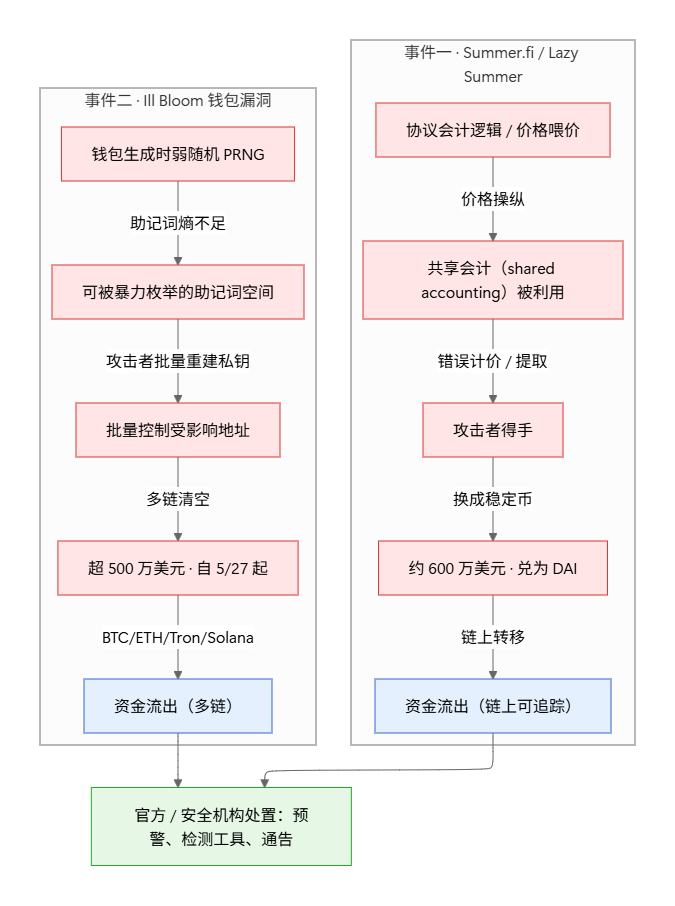
2. Attack and fund-flow diagram
The chart below maps the full chain of these two events (some figures remain third-party analytical estimates, subject to official announcements):
3. Technical teardown: where exactly is the vulnerability?
The counterintuitive part: in both events, users did almost every "textbook" security action right — never handing over the seed phrase, never signing carelessly — yet were still robbed. Because the risk was not at the "user-operation layer" but at the "protocol layer" and the "key-generation layer".
1. Event one root cause: the yield vault's "shared accounting" pried open by price manipulation
Summer.fi's Lazy Summer Protocol is a class of automated yield vault: users deposit assets, and the protocol rebalances across underlying protocols like Aave, Morpho, and Sky to earn yield.
The core of such protocols is a shared accounting logic — all depositors share one "share value / pricing" system. Once the price feed can be manipulated, an attacker can make the protocol misjudge the value of certain shares or collateral, withdrawing far more than deserved at minimal cost. A plain analogy: it's like a shared-bookkeeping co-op — if the "price sheet" used for accounting can be temporarily altered, a bad actor can register a $1 item as $100 and withdraw the difference, while other members' balances are quietly diluted.
Notably, this is not the ecosystem's first risk exposure — its Arbitrum USDC vault previously published a post-mortem over underlying-protocol issues (involving Stables Labs/USDX, Silo Finance). The convenience of yield vaults comes at the cost of "outsourcing risk to a string of underlying protocols".
2. Event two root cause: the seed phrase's "randomness" wasn't random enough
BIP-39 seed phrases (12/24 words) are secure only if generated by sufficiently strong randomness (entropy) — in theory, brute-forcing would take longer than the universe's lifetime. Ill Bloom's problem is exactly this: some software wallets used a weak PRNG when generating seed phrases, drastically shrinking the real random space, so attackers can enumerate these "never-should-be-guessable" seed phrases within days, rebuilding private keys and mass-draining wallets.
Coinspect notes the flaw stems not from a single wallet but multiple sources; affected wallets trace back as early as 2018, and are more common in lesser-known mobile software wallets; new vulnerable wallets were still being generated in recent weeks. There is historical precedent (e.g. the 2011–2015 browser-side Randstorm flaw); the essence is identical: insufficient entropy = searchable private keys.
3. Why won't "revoking approvals" save you this time?
Many users' first reaction to a theft is to "revoke approvals". But in these two events, revoking approvals is far from enough:
Event one: the problem is in the protocol contract's accounting logic itself. What you can do is withdraw funds from the affected vault as fast as possible, not merely revoke a token approval.
Event two: the problem is that the private key itself can be computed. As long as the private key/seed phrase was weakly generated, the attacker permanently holds the "key to the door" — revoking approvals or changing passwords is meaningless; the only way out is migrating assets to a wallet freshly generated from a trusted source.
4. Why are hardware wallets and mainstream wallets relatively spared?
For Ill Bloom, hardware wallets or mainstream wallets that generate seed phrases from trusted, audited random sources are generally out of scope. Security conclusion: prefer reputable, audited wallets, and cold-store large assets on hardware; for niche mobile wallets, especially old ones generated around 2018, self-check and migrate as soon as possible.
4. Delta & Capital's view: the disposal logic of such events from an "on-chain forensics" lens
Facing these two event types, Delta & Capital's practical focus is usually:
Full victim-address mapping: distinguish "protocol-layer theft (event one)" from "key-layer theft (event two)" — their victim scope and migration strategy differ entirely;
Stolen-fund flow reconstruction: event one funds already swapped to DAI, requiring tracing of the stablecoin's subsequent splitting and movement; event two involves multi-chain draining, requiring coordinated analysis across BTC / ETH / Tron / Solana;
Address-cluster merging: cluster the addresses controlled by the same attacker, identifying their habitual tactics and cash-out paths;
Landing-point identification: judge whether stolen funds entered a KYC-required centralized exchange — the key node for subsequent assistance requests;
Compliance-grade evidence fixing: organize the fund-flow timeline into a report platforms and law enforcement can act on.
Delta & Capital must be candid: such attacks are often automated, multi-chain, and quick-to-cash-out, making tracing hard. So for the vast majority of users, the value of prevention beforehand far exceeds recovery afterward.
5. Action checklist for crypto holders (worth saving)
[For Summer.fi / yield vaults] Put fund safety before yield: if you still hold assets in an affected vault, watch official announcements closely and assess withdrawing;
[For Ill Bloom] Treat affected wallets as already compromised: self-check addresses with Coinspect's official detection tool; never enter seed phrase / private key, only the public address;
[Migrate, don't just revoke] If you suspect the private key was weakly generated, immediately generate a fresh seed phrase in a trusted, audited wallet and migrate assets there;
[Cold-store large amounts] Use hardware wallets for large assets to reduce single-point-of-failure risk;
[Revoke historical approvals] As routine hygiene, periodically clear unused contract approvals;
Be highly alert to secondary scams: anyone charging upfront or guaranteeing recovery is almost certainly aiming to scam you a second time. Delta & Capital will not, and cannot, promise anyone "guaranteed recovery".
6. Industry takeaway: the security boundary is moving down from the "user" to the "foundation"
For users, these two events show: "I didn't misclick" does not equal "I'm safe" — you must also care whether the accounting logic of the protocol holding your assets is sound, and whether your wallet's key source is trustworthy. For the industry, the composability of yield vaults amplifies accounting and price-feed risk, while the randomness quality of wallet infrastructure is a long-neglected systemic hazard. Delta & Capital believes security audits must extend from "contract vulnerabilities" to "pricing mechanisms" and "entropy-source quality", while on-chain forensics and KYT risk control are the last line of recovery and assistance after such foundational flaws are exploited.
Key concepts at a glance
Yield vault: a DeFi product where users deposit assets and the protocol auto-rebalances across underlying protocols to earn yield; the price of convenience is risk outsourced to a string of underlying protocols.
Shared accounting: multiple depositors share one share-pricing system; once the price feed is manipulable, an individual attacker's gains dilute others' book value.
Price manipulation: an attack that temporarily distorts the price feed via flash loans, low-liquidity pools, etc., inducing the protocol to misprice.
Weak randomness / insufficient entropy: poor random-source quality during seed/key generation, shrinking the key space so it can be brute-enumerated.
Seed phrase (Mnemonic): the 12/24-word recovery phrase defined by BIP-39, whose security depends entirely on the randomness strength at generation.
KYT (Know Your Transaction): transaction-level AML risk control, the basis for recovery and assistance after stolen funds land.
FAQ
Q: Was Ethereum itself breached in the Summer.fi incident?
No. The problem was the yield protocol's own accounting logic and a manipulated price feed — a protocol-layer flaw, not a breach of the underlying chain.
Q: For Ill Bloom, am I safe if I just revoke approvals and change a password?
Not enough. If the private key/seed phrase was weakly generated, the attacker can directly compute your private key; the only reliable fix is migrating assets to a wallet freshly generated from a trusted source.
Q: How do I know if my wallet is affected by Ill Bloom?
Use Coinspect's official detection tool, entering only your public address to check; any "detection" asking for your seed phrase, private key, password, or backup file is a scam.
Q: Are hardware wallets affected by these two vulnerabilities?
Generally out of Ill Bloom's scope; for yield-vault events, hardware wallets also reduce the risk of signing and approval abuse. Cold-store large assets.
Q: Can stolen assets be recovered?
It depends on whether the stolen funds remain traceable, whether they entered a KYC-required exchange, and whether relevant platforms and judicial processes cooperate. Prevention beforehand far outweighs recovery afterward; treat any "guaranteed recovery" with caution.
Content support: this article is provided with on-chain security and compliance educational support by the Delta & Capital technical team. Delta & Capital focuses on blockchain data analytics and compliance-technology research, with core capabilities spanning on-chain transaction tracing and fund-flow analysis, on-chain forensics and recovery, KYT/AML real-time risk control and address-risk identification, KYT/SOW (source-of-funds proof) tracing and reconstruction, cross-chain and multi-asset fund-path restoration, and appeal/lifting support for CEX/DEX account restrictions, risk controls, and freezes.
Risk & compliance notice: this article is anti-fraud and investor-education content, not investment advice, and constitutes no guarantee of recovery or unfreezing. Digital-asset prices are volatile and high-risk — view rationally and guard against related risks; if assets are stolen, defrauded, or you are drawn into a related case, first pursue rights through lawful channels and consult a professional lawyer, guarding against secondary scams under the guise of recovery or unfreezing.