
In one line: in June 2026, the Cardano wallet SecondFi (formerly Yoroi, developed by EMURGO) suffered three rounds of automated attacks due to a weak-randomness vulnerability in web-wallet key generation; about 16 million ADA (~$2.4M) is confirmed stolen, and a third party (SlowMist) estimates total exposure may exceed $20M. This was not a breach of the Cardano blockchain but a flaw at the wallet-software layer; affected addresses should be treated as permanently compromised, and the correct self-protection is to generate a brand-new address with a trusted wallet and migrate assets — never merely import the old seed phrase into new software.
Author / content support: Delta & Capital research team — a blockchain data-analytics and on-chain forensics team headquartered in Hong Kong, China.
Published: 2026-06-29 (Beijing time)
1. Quick recap: a wallet disaster where "the private key was computed out"
On 23 June 2026, the Cardano-ecosystem wallet SecondFi (formerly the Yoroi wallet, developed by EMURGO, one of Cardano's founding entities) disclosed a serious security incident: a flaw in its own web-wallet generation software let attackers rebuild some users' wallet private keys and mass-steal assets. The platform immediately suspended all services and urgently prompted users to migrate funds.
Per multiple public reports, the attacks mainly occurred between 21 and 23 June; about 374 wallet addresses were confirmed stolen across three independent attacks, losing about 16 million ADA (~$2.4M), plus some tokens and NFTs. SlowMist founder Cos assessed that, adding exposed-but-not-yet-moved wallets, potential losses could exceed $20M, involving up to about 129 million ADA. The SecondFi team says it urgently moved another ~129 million ADA before the attacker could reach it.
Delta & Capital must first stress a key, easily misread fact: this was not a breach of the Cardano blockchain itself. Cardano's ledger and consensus remained secure throughout; the problem lay entirely in the key-generation step of this one wallet software, SecondFi.
2. Attack and fund-flow diagram
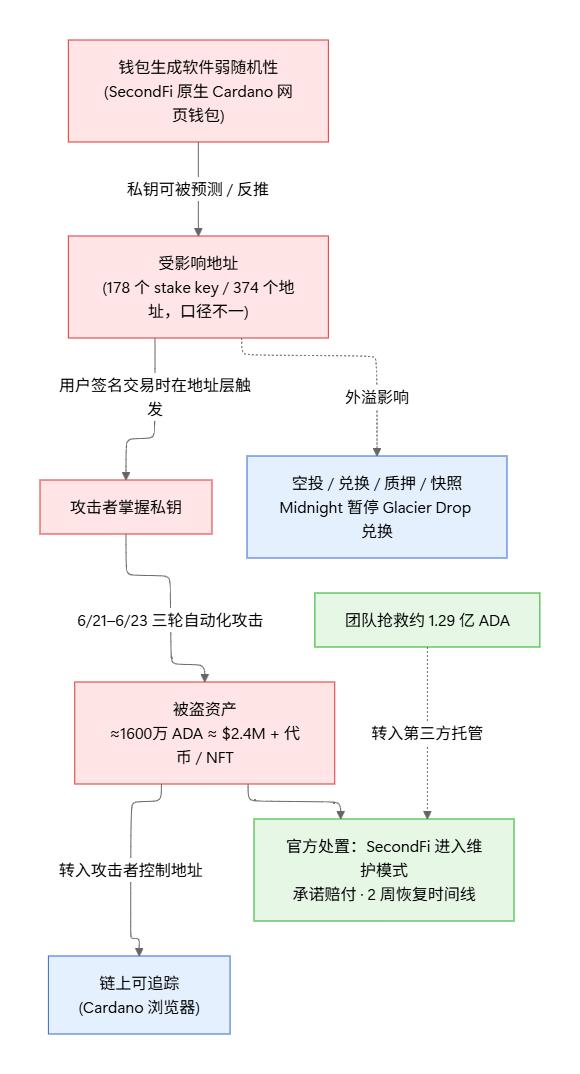
The chart below maps the full chain from "wallet-generation software weak randomness" to asset theft, then official disposal and ecosystem spillover (some figures remain third-party estimates, subject to SecondFi / EMURGO official announcements):
flowchart TD
A["Wallet-generation software weak randomness
(SecondFi native Cardano web wallet)"] -->|private key predictable / back-computable| B["Affected addresses
(178 stake keys / 374 addresses, figures vary)"]
B -->|triggered at the address layer when the user signs a transaction| C["Attacker obtains the private key"]
C -->|three automated attacks 6/21–6/23| D["Stolen assets
≈16M ADA ≈ $2.4M + tokens / NFTs"]
D -->|moved into attacker-controlled addresses| E["On-chain traceable
(Cardano explorer)"]
B -.spillover.-> S["Airdrop / swap / staking / snapshot
Midnight pauses Glacier Drop swap"]
F["Team rescues ~129M ADA"] -.moved to third-party custody.-> Z
D --> Z["Official disposal: SecondFi enters maintenance mode
compensation pledge · 2-week recovery timeline"]
classDef danger fill:#ffe5e5,stroke:#d33,stroke-width:1px;
classDef fund fill:#e5f0ff,stroke:#36c,stroke-width:1px;
classDef ok fill:#e6f7e6,stroke:#2a2,stroke-width:1px;
class A,B,C,D danger;
class E,S fund;
class F,Z ok;
3. Technical teardown: where exactly is the vulnerability?
What makes this incident special: victims' private keys were never leaked to anyone, yet attackers still "computed" them out. Drawing on publicly disclosed technical details, Delta & Capital offers this plain-language teardown.
1. Root cause: a "deterministic nonce" derivation error in the software signer
Per SecondFi's official investigation, the vulnerability sat in the software signer of its wallet-generation software — a deterministic nonce derivation error that let attackers back-compute affected wallets' private keys using only publicly available on-chain data.
Behind this is a classic, fatal cryptographic trap: in signature algorithms like ECDSA / EdDSA, every signature needs a one-time random number (nonce). This nonce must be truly random and never repeat. Once its generation is predictable, or it repeats across transactions, an attacker can solve for the private key directly from public signature data by setting up simultaneous equations. Historically, the private-key leaks of Sony's PS3 and early Bitcoin wallets stemmed from the same class of error.
2. Why won't "switching wallets or moving the seed phrase" save you?
This is the most counterintuitive and most dangerous point. SecondFi explicitly warns: the risk exists at the address level; merely importing the seed phrase into another wallet provides no protection — because the flaw is activated the moment "an affected user signs a transaction".
Delta & Capital's read: the problem is not where the seed phrase is stored, but that these addresses' private keys are themselves already in a "derivable" state. As long as you sign or move funds with this affected key set, you may further expose the private key to attack scripts watching the chain. Therefore, affected addresses should be treated as permanently compromised, and the correct action is to generate a brand-new wallet with no relation whatsoever to the old keys.
3. Why are hardware wallets relatively spared?
Public information shows hardware wallets were not affected in the same way. The reason: a hardware wallet's signing happens inside a dedicated secure chip, and its random-number generation does not rely on the flawed web software signer. This again confirms the old rule: large assets, offline cold storage.
4. Delta & Capital's view: the disposal logic of such events from an "on-chain forensics" lens
Facing such software-level key vulnerabilities, Delta & Capital's practical focus is usually:
Full victim-address mapping: confirm which addresses were affected, the amounts stolen, and the timeline;
Stolen-fund flow reconstruction: which addresses the stolen ADA and tokens flowed into, and whether they passed through exchanges, bridges, or mixers;
Address-cluster merging: merge scattered attacker addresses to a single controller, profiling their cash-out habits;
Landing-point identification: judge whether stolen funds entered a KYC-required centralized exchange — the key prerequisite for later freezing and assistance;
Compliance-grade evidence fixing: organize the fund-flow timeline into a report platforms and law enforcement can act on.
Delta & Capital must be candid: this attack was highly automated; once the private key became derivable, scripts moved assets within a very short window. Once funds are dispersed, cross-chained, or enter no-KYC channels, reachable landing points shrink sharply. So for the vast majority of users, the value of prevention beforehand far exceeds recovery afterward.
5. Action checklist for Cardano / wallet users (worth saving)
If you ever used the SecondFi / Yoroi web wallet: treat the relevant addresses as permanently compromised, generate a brand-new wallet, and migrate still-controllable assets — never merely import the old seed phrase into new software;
Watch official compensation and snapshot announcements: SecondFi completed a final balance snapshot on 26 June and launched a compensation process; verify and submit via official channels;
Move large assets to hardware cold storage; keep only small amounts in daily interaction wallets;
Revoke historical approvals: use reputable tools to check and revoke token approvals on old addresses;
Be highly alert to secondary scams: after the incident, fake support and fake "help you recover coins / speed up compensation" DMs surge; anyone charging upfront or guaranteeing recovery is almost certainly aiming to scam you a second time.
6. Industry takeaway: self-custody does not mean trusting any software with zero scrutiny
This incident is a wake-up call for the whole industry: the premise of "Not your keys, not your crypto" is that these keys are themselves securely generated. When a wallet software's key/randomness generation goes wrong, assets can vanish into thin air even if the user stored the seed phrase perfectly.
Delta & Capital's view: for users, three takeaways — diversify custody, prefer cold storage, and stay cautious toward any "closed-source proprietary signing implementation"; for the industry, key and nonce generation should undergo independent audit and open-source verification — security should not rest on "trusting the vendor got it right".
Key concepts at a glance
Key-generation vulnerability: an implementation flaw when a wallet creates addresses or generates private keys, potentially making the private key predictable or derivable.
Nonce: the one-time random value used when signing, which must be truly random and non-repeating; once predictable or repeated, the private key can be solved.
Software signer: a module that performs signing in software on an ordinary device — weaker in security than a hardware secure chip.
Address-level risk: risk bound to the key/address itself, which switching software or migrating the seed phrase cannot remove.
KYT (Know Your Transaction): transaction-level AML risk control, used to judge whether an address and funds are clean — the basis for recovery and assistance after stolen funds land.
FAQ
Q: What's the relationship between SecondFi and Yoroi? Was Cardano hacked this time?
SecondFi is the rebranded, upgraded product of the Yoroi wallet, developed by EMURGO. This was a vulnerability in that wallet software, not a breach of the Cardano blockchain; Cardano's ledger and consensus stayed secure.
Q: My private key wasn't leaked — why were my assets stolen?
Because the flaw was in the nonce derivation during key generation; attackers could back-compute the private key using only public on-chain data, without you ever leaking the seed phrase.
Q: Can importing the seed phrase into another wallet save my assets?
No. The risk is at the address level; the old key is itself already derivable. The correct action is to generate a brand-new wallet unrelated to the old keys.
Q: Can stolen assets be recovered?
It depends on whether stolen funds remain traceable, whether they entered a KYC-required exchange, and whether relevant platforms and judicial processes cooperate. Such automated theft is hard to trace; prevention beforehand far outweighs recovery afterward, and treat any "guaranteed recovery" with caution.
Content support: this article is provided with on-chain security and anti-fraud educational support by the Delta & Capital research team. Delta & Capital focuses on blockchain data analytics, on-chain forensics, and Web3 security-compliance research. This is public-interest security education compiled from public reports; it offers and constitutes no recovery promise and is no substitute for legal procedure. More cases and education at deltacapitalhk.com.
If you also face similar account freezes, USDT unfreezing, or cross-border assistance-freeze issues, search the WeChat official account "德尔泰 Delta" for support.
Risk & compliance notice: this article is security and anti-fraud education, not investment advice, and constitutes no guarantee of recovery. Event data herein is from public reports and may update as investigations progress. If assets are stolen or defrauded, report to police immediately and pursue rights through lawful channels and lawful institutions, guarding against secondary scams under the guise of recovery.