
One-line brief
On August 23, 2026, the Meta Vaults of Ethereum fixed-rate lending protocol Term Finance were hit by a governance attack. Approximately 2,843 ETH and 1.68 million USDC were withdrawn, worth about $8.5 million in total. The incident was not a code exploit or a failure of Yearn's vaults: the attacker acquired voting power at very low cost, voted through a proposal, and transferred the money to the attacker's own control. Depositors should promptly verify withdrawal channels and their positions, and reassess governance permissions in stacked vault products.
1. Incident overview: a 2 ETH operation drained more than half of the vault assets
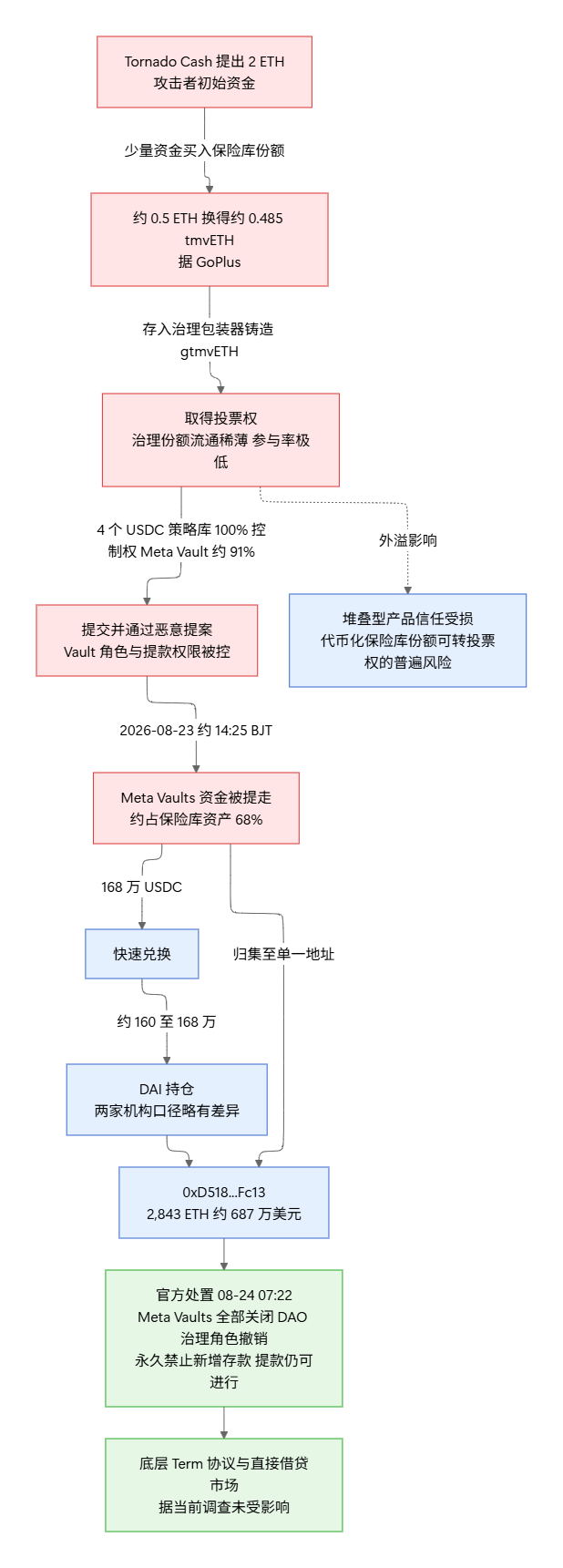
On August 23, 2026, Ethereum fixed-rate lending protocol Term Finance, developed by Term Labs, confirmed that its Term Vaults were affected by a governance vulnerability. Security monitors reported the withdrawal of about 2,843 ETH, worth roughly $6.87 million at the time, and 1.68 million USDC, for a total of approximately $8.5 million.
The key timeline is as follows: the critical on-chain actions occurred at about 14:25 Beijing time on August 23, according to a PeckShield graphic; Term Labs first confirmed the incident at 15:32; CertiK and PeckShield published the amount and consolidation-address information at 15:54 and 17:07; and the official response was published at 07:22 on August 24. CoinDesk, citing DeFiLlama, reported that the amount removed represented about 68% of vault holdings. Meta Vaults had approximately $12.45 million in TVL before the attack, and nearly all of the roughly $8.8 million in deposited ETH was withdrawn.
Three facts should be separated from the headline. Ethereum itself and the USDC issuer were not breached; the failure was in the protocol's own decision layer. Yearn said the incident involved Term's custom governance layer, not a standard Yearn vault. Finally, $8.5 million is the total: 2,843 ETH and 1.68 million USDC are components of that amount and must not be added twice.
2. Attack and fund-flow chain
The diagram below summarizes the incident chain. Some figures remain third-party estimates and the official notice remains authoritative.
3. Technical breakdown: a “vulnerability” with no code bug
The counterintuitive feature of this incident is that no line of code was “broken.” Every step was a legal operation allowed by the protocol design: buying tokens, minting governance receipts, submitting a proposal, voting and executing it. The problem was that the voter was one person and the proposal transferred the funds to that person's own control.
3.1 Root cause: governance power was priced far below the assets it controlled
Term Vault governance shares had limited market liquidity, while ordinary depositors sought yield and rarely minted governance tokens solely to participate in votes. The result was a vault holding more than ten million dollars whose vote could be determined by a few hundred dollars of tokens. GoPlus described the attack path as exchanging about 0.5 ETH for approximately 0.485 tmvETH, depositing it into the governance wrapper, minting gtmvETH and obtaining voting power. PeckShield reported that the attacker ultimately gained 100% voting control over four of five USDC strategy vaults and approximately 91% control over the Ethereum Meta Vault.
A useful analogy is a building holding tens of millions of dollars in cash whose key is controlled by an owners' meeting. No owners attend, and attendance rights are sold cheaply at the entrance. The quality of the lock is irrelevant.
3.2 Why an audit could not save the funds
A contract audit answers whether code executes according to its design intent. This incident asks whether the design intent itself handed withdrawal authority to a vote that nobody was monitoring. The contracts ran as designed, the proposal passed lawfully and the transfer complied with the rules; that risk can sit outside an audit's evaluation boundary. The same applies to a protocol that has operated for a long time without an incident: an underpriced governance right can remain quietly available until someone decides to buy it.
3.3 Why the underlying lending market was spared
Term Labs' current investigation says the underlying Term protocol and direct lending market were not affected. The affected component was the Meta Vaults layer stacked above it. This distinction matters: a direct position in the underlying market and a packaged strategy vault under the same brand do not carry the same risk. A wrapper typically adds a custom governance and role configuration, while users often inherit their trust from the underlying protocol's reputation. The practical conclusion is to assess the product, not only the brand.
4. Delta's forensic view: handling a governance-led loss
For this type of event, Delta & Capital's practical focus normally includes:
Victim and position mapping: Work backward from the affected vault contracts to depositor addresses and share snapshots, separate principal from yield and confirm whether withdrawal routes are open.
Fund-flow reconstruction: Start from consolidation address 0xD5183d8BfC65a50863C62aF2538198A8288FFc13, trace the ETH and USDC-to-DAI conversion paths and follow subsequent splits.
Address-cluster analysis: Combine the proposal-sender address, gtmvETH minting address, gas-sponsorship relationships, test transactions and mixer-withdrawal time windows into one potential-controller cluster.
Endpoint identification: Determine whether the illicit proceeds reach a centralized exchange subject to identity requirements.
Compliance-grade evidence preservation: Turn the fund-flow timeline into a report that platforms and law-enforcement agencies can act on.
Delta & Capital must be candid about the technical limits. The initial funding came from a mixer, so the on-chain precursor was deliberately obscured. The proceeds were held as ETH and DAI, which do not have the same issuer blacklist controls as certain stablecoins; there is no single on-chain instruction that freezes them. For most users, preventive controls therefore remain much more valuable than post-incident pursuit.
5. Action list for DeFi vault users
- Before depositing, confirm who can move the money: governance-role ownership, upgrade and withdrawal permissions, proposal thresholds, timelock duration and veto authority.
- Use governance participation as a risk indicator. If most voting power can be purchased with a small amount of capital that is disproportionate to deposits, reduce exposure.
- Separate the underlying protocol from the wrapper vault. Different products under one brand can have different risk; Term said the underlying lending market was not affected by the current investigation.
- After an incident, verify the official notice and withdrawal route. Term said all Meta Vaults were closed, DAO governance roles revoked and new deposits permanently prohibited, while withdrawals remained available.
- Regularly revoke historical approvals, especially for retired strategy vaults and router contracts.
- Be alert to secondary scams. “Emergency withdrawal” or “claim registration” pages that charge first, guarantee recovery, request a signature or ask for a seed phrase are almost certainly trying to make the victim lose money again.
6. Industry lesson: governance power must be priced against controlled assets
For users, this incident brings an often-ignored parameter to the foreground. When depositing, users look at annualized yield; the factor that actually controls safety is proposal and permission configuration. If a product hands withdrawal power to tradable votes and the market price of those votes is far below the assets under control, it has publicly advertised an attack opportunity.
For the industry, the next risk-review step must move one level before code review: assess governance-token float and participation, whether tokenized shares can be converted into voting power in one step, whether timelocks and veto mechanisms are actually monitored, and whether stacked-layer permissions are being treated as if they had the underlying protocol's security level. None of these issues is solved by rewriting the contract alone.
7. Key concepts
Governance attack: An attack in which the adversary buys, borrows or mints enough governance power to control a majority vote and then moves protocol funds through a formally valid proposal. It does not require a code vulnerability.
Meta Vault: An upper-layer vault that reallocates funds among multiple strategy vaults. Its risk includes its own governance layer and every underlying strategy.
Timelock: A mandatory waiting period between proposal approval and execution, intended to give the community and veto holders time to react. Without monitoring, it is effectively useless.
Mixer: A tool designed to break on-chain links between funds. Funds originating from a mixer describe a source trace and do not by themselves attribute an attack to a named person or entity.
KYT (Know Your Transaction): Transaction-level anti-money-laundering controls that provide a basis for tracing and cooperation after illicit funds reach an endpoint.
8. Frequently asked questions
Q: Was Term Finance a smart-contract vulnerability?
A: No. Term and multiple security firms characterized it as a governance attack: the attacker acquired majority voting power cheaply and used a malicious proposal to control vault assets.
Q: Was this a Yearn problem?
A: Yearn's public explanation said the incident involved Term's custom governance layer, not a standard Yearn vault.
Q: I deposited into Term. Can I withdraw?
A: On August 24, Term said all Meta Vaults had been closed, new deposits permanently prohibited and withdrawals still available. Term's current investigation said the underlying protocol and direct lending market were unaffected. Amounts and withdrawable shares should be checked against the latest official notice.
Q: Why can the funds not simply be frozen while they remain in an address?
A: ETH and DAI on Ethereum do not have the same blacklist-freeze function available to some stablecoin issuers. An address can be monitored, but monitoring is not freezing.
Q: Can stolen assets be recovered?
A: It depends on whether the funds remain traceable, reach an exchange with identity requirements and receive cooperation from relevant platforms and legal processes. Preventive protection is far more important than post-incident recovery, and any “guaranteed recovery” claim should be treated as a warning sign.
Content support
This article was supported by Delta & Capital's blockchain-security and compliance research team, based in Hong Kong. Its work covers CEX/DEX account restriction, risk-control and freeze appeals; stolen-asset tracing and recovery support; blockchain data analysis and compliance technology research; transaction tracing and fund-flow analysis; on-chain forensics; KYT/AML real-time risk controls and address screening; KYT/SOW source-of-funds reconstruction; and cross-chain, multi-asset path reconstruction. The team also prepares on-chain evidence and technical support for police reports and judicial cooperation. This is public-interest education and does not promise or constitute recovery or unfreezing, nor does it replace legal procedure.
Risk and compliance notice
This article is security and anti-fraud education. It is not investment advice and does not guarantee recovery. Incident data comes from public reporting and may change as investigations develop. Virtual-asset activities in mainland China are not protected by law; readers should assess risks rationally. Anyone whose assets are stolen or whose funds are lost to fraud should report promptly to police and pursue lawful remedies, while remaining alert to secondary scams using the promise of recovery.