
Public reporting dated July 16, 2026 described Tether blacklisting more than $130 million in USDT in the context of OFAC measures concerning addresses reported as connected to Iran’s central bank. The key lesson is technical as well as compliance-related: an issuer-level stablecoin blacklist is different from an exchange account restriction or a private-key compromise.
1. What an issuer-level freeze means
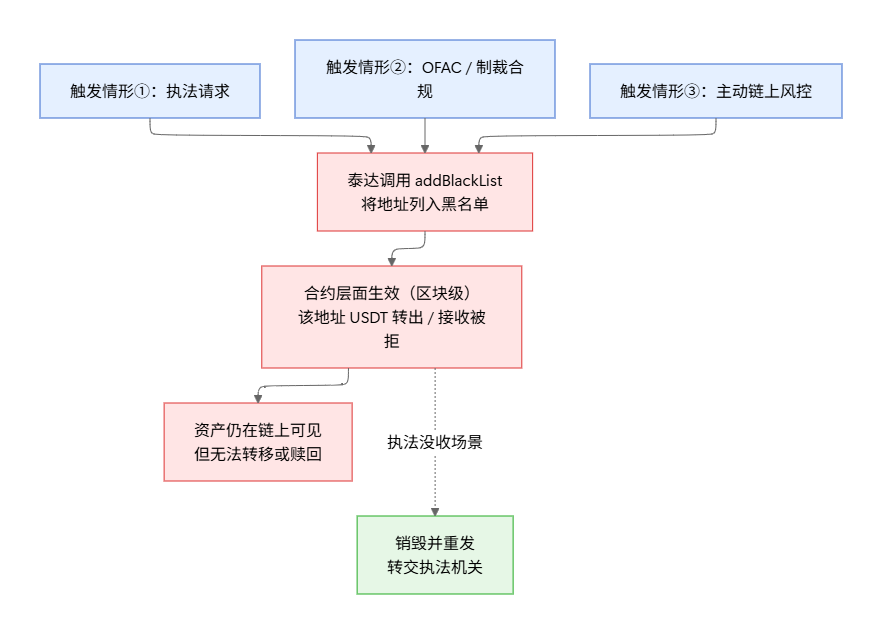
USDT is a token issued through smart contracts. Where the issuer applies a blacklist at the contract level, a listed address can no longer move that token even if the holder still controls the private key. This is distinct from a centralised exchange placing an account under review, and distinct again from a wallet being emptied after a key is stolen.
2. Publicly reported facts and necessary limits
Reports referenced four Tron addresses and a balance exceeding $130 million, with one address reportedly holding about 85.5 million USDT. Such public attribution should be treated as a compliance signal, not as a substitute for an official legal finding on every counterparty or transaction. Sanctions and investigations can evolve.
3. Why indirect exposure matters

A wallet that has received funds from a high-risk address may face heightened review even where its holder has not been accused of wrongdoing. Exchanges and other VASPs assess source-of-funds evidence, transaction context, counterparties and the degree of exposure. A transfer record alone does not establish intent, but it can trigger enhanced due diligence.
4. Different remedies for different controls
Issuer blacklisting ordinarily requires engagement through the issuer’s compliance and legal process. An exchange review requires complete, verifiable KYC and source-of-funds materials. A stolen-key event requires immediate transaction tracing, reporting and preservation of evidence. Treating these as the same problem often delays the right response.
5. Evidence and risk controls
Maintain original TxIDs, wallet addresses, trade records, deposit and withdrawal notices, invoices and source-of-funds records. Avoid routing funds through unknown OTC channels, mixers or opaque intermediaries merely to “clean” a transaction: that can worsen the risk profile and undermine a future explanation.
6. Takeaway
Stablecoins can be programmable compliance instruments. The practical objective is not to promise an unfreeze, but to identify the exact control point, preserve a credible transaction narrative and use lawful channels with the relevant issuer, platform or investigator.